
How Should You Structure a Weekly Workout Routine After 40? A Science-Backed Schedule for Women

Quick Read: The Four Design Choices
Choice 1 — Full-body, not split routines. A 12-week RCT in 50 untrained women found that a full-body routine 2× per week produced the same strength and muscle gains as a 4-session upper/lower split — at half the time cost. Full-body wins on adherence and recovery for women over 40.
Choice 2 — Compound movements first, isolation last. Larger muscle groups recruit more muscle mass and produce a stronger hormonal response. Start with squat or hinge variations when your nervous system is fresh; finish with smaller assistance work.
Choice 3 — Strength before cardio. A 2026 meta-analysis in postmenopausal women found that performing resistance training BEFORE aerobic exercise produced marginally greater body composition improvements (ES = -0.09) and metabolic benefits (ES = -0.28) than the reverse order.
Choice 4 — Hard sessions early in the day, spaced across the week. Place strength sessions 48–72 hours apart (Mon/Wed/Fri pattern). Schedule intense work before 5pm to avoid disrupting the cortisol-melatonin rhythm that perimenopause already strains.
The result: 3 strength sessions × 20–30 minutes + 150 minutes of walking, with each design choice optimised for women over 40's hormonal context and recovery capacity.
If you've ever wondered whether your weekly workout routine is structured the right way — full-body or split? Cardio before or after weights? Which exercise first? — the answer is more specific than "it depends." The research has tested these design choices directly in women over 40 and postmenopausal women, and the verdicts are surprisingly clear.
This article walks through the four structural design choices that determine whether a weekly routine works for a woman in her 40s or 50s, what the RCTs and meta-analyses show, and how to translate the findings into a concrete weekly schedule you can start this week. For the broader plan philosophy, see what should a workout plan for women over 40 look like.
The Four Structural Design Choices
Full-Body Routines vs Upper/Lower Splits
The biggest scheduling decision: do you train your whole body each session, or split it into upper-body and lower-body days? The most direct comparison comes from a 12-week randomised trial in 50 resistance-untrained women published in BMC Sports Science, Medicine and Rehabilitation.
Participants were randomised to either a full-body routine (2 sessions per week, all major muscle groups each session) or an upper/lower split (4 sessions per week, 2 upper-body + 2 lower-body). Both groups did the same total weekly volume. The result: no between-group differences in any outcome. Bench press 1RM increased 25.5% (full-body) vs 30.0% (split). Lat pulldown: 27.2% vs 26.0%. Leg press: 29.2% vs 28.3%. Muscle mass: 1.9% vs 1.7%. Jump height: 12.5% in both groups. (Source: Pina et al., BMC Sports Sci Med Rehabil, 2022)
Why does this matter? Because the full-body group achieved the same results in half the weekly time commitment (2 vs 4 sessions). For women over 40 — where recovery takes longer and time is constrained — full-body is the structurally efficient choice. It also distributes load across the week more evenly, leaving room for walking and stress management.
The rule: Use full-body workouts. Three sessions per week (Mon/Wed/Fri pattern), each hitting all 5 movement patterns — squat, hinge, push, pull, lunge.
Exercise Order Within a Session
The principle is consistent across resistance training research: start with the exercises that recruit the most muscle mass and require the most neural focus. That means compound multi-joint movements first (squat, hinge, push, pull) when the nervous system is fresh; smaller isolation work — if you do any — at the end.
Two reasons. First, compound exercises produce a stronger systemic adaptive response: greater hormonal stimulus (growth hormone, testosterone, IGF-1) and broader functional carryover. (Source: Taipale et al., Sports Medicine, 2022) Second, doing the hardest, most technical work when fatigued increases injury risk — particularly relevant after 40, when connective tissue elasticity has declined.
A practical sequencing template for a full-body session: (1) lower-body compound (squat or hinge) → (2) upper-body push (push-up variation) → (3) upper-body pull (inverted row) → (4) unilateral lower (lunge or step-up) → optional (5) core/accessory work.
The rule: Lower-body compound first, then upper-body push, then upper-body pull, then unilateral leg work. Five movements, 2–3 sets each, in 20–30 minutes.
Strength Before Cardio (When You Combine Them)
If you train both strength and cardio in the same session — concurrent training — the order matters. A 2026 meta-analysis on concurrent training in postmenopausal women directly tested the sequence question. Performing resistance training BEFORE aerobic exercise produced marginally greater body composition improvements (ES = -0.09, P = 0.03) and greater metabolic improvements (ES = -0.28, P = 0.01) compared to performing aerobic first. (Source: Concurrent Training Meta-Analysis, BMC Women's Health, 2026)
The mechanism is straightforward: doing cardio first depletes the glycogen and creates muscular fatigue that blunts the strength training stimulus. Doing strength first means your nervous system and muscles are fresh for the higher-priority adaptation, with cardio acting as a finisher that still drives cardiovascular and fat-loss benefits.
For most women over 40, the cleaner solution is to separate strength and cardio onto different days rather than combining them. But if combining is necessary (a busy week, limited time), the order is now research-backed.
The rule: Separate strength and walking onto different days when possible. If combining, strength first, walking after — never the reverse.
Weekly Placement: Spacing and Timing
Two principles govern weekly placement after 40: spacing (recovery between hard sessions) and timing (time of day).
Spacing. Postmenopausal women experience approximately 20% longer recovery periods after exercise, with C-reactive protein roughly 35% higher than premenopausal women. (Source: Romualdi et al., Endocrines, 2024) This means same-muscle sessions need 48–72 hours between them. A full-body Mon/Wed/Fri pattern delivers exactly this gap and keeps weekends open for longer walks or rest.
Timing. Intense exercise elevates cortisol acutely. Doing it in the evening can disrupt the natural cortisol decline that supports sleep onset — particularly problematic during perimenopause when cortisol rhythm is already disrupted. (Source: Woods et al., Seattle Midlife Women's Health Study, 2009) Where schedule allows, place strength training before 5pm. Walking is hormonally neutral and can happen anytime.
The rule: Mon/Wed/Fri strength sessions, ideally before 5pm. Tuesday/Thursday/Saturday walks. One full rest day per week.
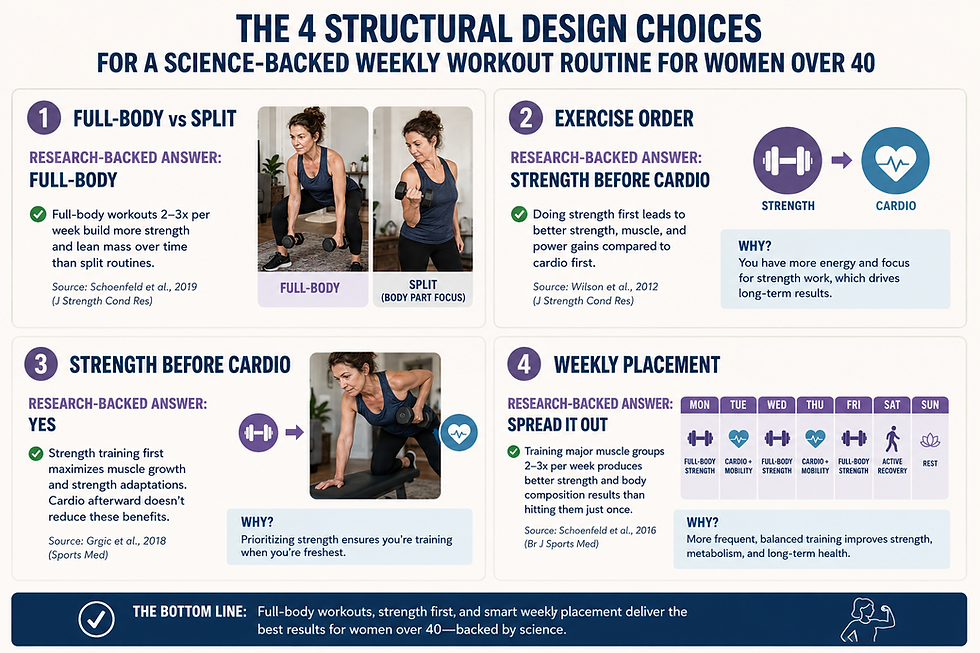
What Does the Weekly Schedule Look Like?
Applying the four design choices to a real week:
Day | Activity | Duration | Why This Slot |
Monday | Strength A (full-body, 5 movements) | 20–30 min | Fresh start to the week; sets the foundation |
Tuesday | Brisk walk | 30 min | 48-hour gap from Monday strength; supports recovery |
Wednesday | Strength B (full-body, same 5 movements) | 20–30 min | Mid-week placement; muscles fully recovered |
Thursday | Brisk walk or yoga | 30 min | Active recovery; cortisol management via yoga |
Friday | Strength A or B (alternate) | 20–30 min | Pre-weekend strength; protects the muscle-building signal across the week |
Saturday | Longer walk, hike, or swim | 45–60 min | Time and energy for a longer, lower-intensity session |
Sunday | Rest or gentle mobility | Optional | Full recovery day; HPA axis reset |
This structure delivers 3 strength sessions, 150+ minutes of walking, one mobility/stress session, and one full rest day. It matches the clinical recommendations and applies all four design choices. (Source: Buckinx & Aubertin-Leheudre, 2022)
What Each Strength Session Actually Looks Like
Inside each 20–30 minute session: (1) 5-minute warm-up — joint-specific movement prep. (2) Lower-body compound — squat variation (chair squat → bodyweight → tempo → single-leg), 2–3 sets of 8–12 reps. (3) Upper-body push — push-up variation (wall → incline → knee → full), 2–3 sets of 8–12 reps. (4) Upper-body pull — inverted row variation, 2–3 sets of 8–12 reps. (5) Hinge or lunge — glute bridge, single-leg variation, or step-up, 2–3 sets of 8–12 reps. (6) Optional 2–3 minutes of core. Last 2–3 reps of each set should feel genuinely challenging.
"The structure of a weekly routine matters as much as the exercises in it. Full-body routines deliver the same results as splits in half the time. Compound movements first protect both safety and the hormonal response. Strength before cardio when you combine them. And spacing hard sessions 48–72 hours apart respects the recovery system after 40. These aren't preferences — they're the design choices the research keeps validating. TransformFitAI is built around all four."
— Nikolay Atanasov, Founder of TransformFitAI
Common Structural Mistakes to Avoid
Three errors most commonly break an otherwise good routine after 40:
Mistake 1: Splitting your routine just because it "feels more serious." Upper/lower or push/pull splits originated in bodybuilding traditions designed for trained athletes accumulating high weekly volume. For untrained or moderately trained women over 40, the RCT data shows full-body produces equivalent results at half the time cost. The "more sessions = more results" assumption doesn't hold.
Mistake 2: Doing cardio before strength on combined days. Cardio first depletes glycogen and blunts the strength stimulus. The 2026 BMC meta-analysis shows strength-first is marginally but consistently better for body composition and metabolic outcomes in postmenopausal women.
Mistake 3: Stacking hard sessions on consecutive days. Recovery takes ~20% longer after menopause. Two hard strength sessions on consecutive days for the same muscle groups exceed the body's repair capacity, leading to underperformance and eventually overreaching. The Mon/Wed/Fri spacing isn't arbitrary — it's the minimum recovery window.
The same plan that works in January often stops working by March. After 40, hormones, muscle, and recovery capacity all shift across the perimenopausal window — sometimes month to month. A static plan can't keep pace.
How TransformFitAI Applies These Design Choices
Every structural choice in TransformFitAI's programming is one of these four research-backed decisions:
Full-body sessions, three times per week. The RCT-validated structure. All five movement patterns in every session. Hits each major muscle group with the 48–72 hour recovery gap built in.
Compound movements first. Every workout opens with a lower-body compound (squat or hinge), then upper-body push, then pull, then unilateral work. The order is preset; you don't have to think about it.
Strength foundation, walking as complement. The app handles the strength side. Walking is encouraged as separate-day activity, not bolted onto strength sessions — matching the cleaner separation that produces better outcomes.
Bi-weekly progression matches recovery. Every 14 days, the AI advances variations based on demonstrated progress. The spacing of progression respects the same recovery capacity that determines the Mon/Wed/Fri rhythm.
Your Weekly Routine Structure Checklist
✓ Use full-body workouts. 3 sessions per week × 20–30 minutes. Same results as 4-session splits, half the time.
✓ Order exercises: compound first, isolation last. Lower-body compound → push → pull → unilateral leg → optional core.
✓Separate strength and cardio onto different days when possible. If combining, strength first, walking after.
✓ Space strength sessions 48–72 hours apart. Mon/Wed/Fri pattern works for most schedules.
✓Schedule intense exercise before 5pm. Avoids disrupting the cortisol-melatonin rhythm strained by perimenopause.
✓Include one full rest day per week. Recovery is part of the structure, not the absence of it.
✓ Walk 150 minutes per week. Distributed across non-strength days. Supports cortisol management and cardiovascular health.
Ready for a routine structured by the research?
TransformFitAI applies all four structural design choices — full-body sessions, compound-first ordering, strength-before-cardio sequencing, and 48–72 hour recovery spacing — to deliver an evidence-based weekly routine for women over 40. 3 sessions × 20–30 min. No gym. Try it free for your first day, then $1.99 for your first month.
$1.99 / first month
First training day completely free · 30-day money-back guarantee · Cancel anytime
Frequently Asked Questions Is a full-body or split workout routine better for women over 40?
Full-body, in most cases. A 12-week randomised trial in 50 resistance-untrained women compared a full-body routine (2 sessions per week, all muscle groups each session) against an upper/lower split (4 sessions per week). Both groups did equal weekly volume. There were no between-group differences in any outcome — bench press, lat pulldown, leg press, muscle mass, or jump height all improved equally. Full-body produced the same results at half the time cost, making it the structurally efficient choice for women over 40.
Should you do cardio before or after weights after 40?
After. A 2026 meta-analysis on concurrent training in postmenopausal women found that performing resistance training before aerobic exercise produced marginally greater body composition improvements (ES = -0.09, P = 0.03) and greater metabolic improvements (ES = -0.28, P = 0.01) compared to performing aerobic first. Cardio first depletes glycogen and blunts the strength stimulus. Strength first preserves the higher-priority adaptation while cardio still drives cardiovascular and fat-loss benefits.
What order should exercises go in within a workout?
Compound multi-joint movements first, isolation work last. A practical sequence for a full-body session: lower-body compound (squat or hinge), upper-body push (push-up variation), upper-body pull (inverted row), unilateral leg work (lunge or step-up), optional core/accessory work. Two reasons: compound exercises produce a stronger systemic hormonal response and have higher technical demands that benefit from a fresh nervous system. Doing the hardest work when fatigued increases injury risk.
How many days between strength workouts after 40?
48–72 hours between sessions that target the same muscle groups. Postmenopausal women experience approximately 20% longer recovery periods after exercise, with C-reactive protein roughly 35% higher than premenopausal women. A Monday/Wednesday/Friday full-body pattern delivers exactly this spacing — each muscle group gets 2–3 days of recovery before being trained again, while walking on Tuesday/Thursday/Saturday supports active recovery without adding training stress.
How does menopause affect a workout plan?
Three measurable changes during perimenopause and menopause require plan adjustments. Recovery takes approximately 20% longer, so plans should include rest days between sessions for the same muscle groups. Declining estrogen reduces connective tissue elasticity, making joint-friendly exercise selection important. Rising cortisol and disrupted sleep mean intense exercise should be timed earlier in the day. The fundamental structure — strength + walking + recovery — stays the same; the volume and timing become more important.
What time of day should women over 40 work out?
For intense exercise, before 5pm where possible. Intense exercise elevates cortisol acutely; doing it in the evening can disrupt the natural cortisol decline that supports sleep onset — particularly problematic during perimenopause when the cortisol-melatonin rhythm is already strained. Walking is hormonally neutral and can be done anytime. If evening sessions are the only option, that's still better than skipping training — but morning or afternoon is the physiological sweet spot after 40.
Can I do strength training every day if I keep sessions short?
Not for the same muscle groups. Even short sessions create muscle damage that requires 48–72 hours to fully repair after 40. Training the same muscles on consecutive days exceeds the body's repair capacity regardless of session length and leads to underperformance over weeks. If you want to train more than 3 days per week, alternate hard strength sessions (Mon/Wed/Fri) with light cardio, yoga, or walking (Tue/Thu/Sat). Five hard strength sessions per week is the structural pattern most likely to push women over 40 into overreaching.
Scientific References
Pina FLC, et al. A randomized trial on the efficacy of split-body versus full-body resistance training in non-resistance trained women. BMC Sports Sci Med Rehabil, 2022. PMC9107721
Concurrent Training Meta-Analysis. Effects of concurrent training on body composition, metabolic, and inflammatory in postmenopausal women: a meta-analysis. BMC Women's Health, 2026. BMC Women's Health
Taipale R, et al. Effects of Exercise on Testosterone in Women Aged ≥40 Years: Systematic Review. Sports Medicine, 2022. PubMed
Romualdi D, et al. Hormonal Influences on Skeletal Muscle Function in Women across Life Stages. Endocrines, 2024. Endocrines
Woods NF, et al. Cortisol Levels during the Menopausal Transition. Menopause / PMC, 2009. PMC2749064
Buckinx F, Aubertin-Leheudre M. Sarcopenia in Menopausal Women. Int J Womens Health, 2022. PMC9235827
Medical Disclaimer: TransformFitAI is a general wellness tool and not a substitute for medical advice. Consult your physician before starting or modifying an exercise programme, especially if you have existing health conditions or are taking medications. Individual results may vary.



Comments