
How Many Days a Week Should a Woman Over 40 Exercise? What the Clinical Guidelines Recommend
Updated: May 29

Quick Read: The Numbers
The clinical answer: 3 strength training sessions per week + 150 minutes of moderate aerobic activity (walking). This is the consensus recommendation across ACSM, NSCA, WHO, and the most cited postmenopausal protocol.
2 vs 3 sessions per week — head to head: A 2024 RCT in 83 postmenopausal women (ages 50–65) compared 2 vs 3 sessions of multicomponent training over 12 weeks. The 3-days-per-week group showed better outcomes across multiple parameters than the 2-days-per-week group.
The mechanism is biological, not behavioural: Three age-related changes drive slower recovery: declining satellite cell function (the stem cells that rebuild muscle), elevated systemic inflammation, and disrupted deep sleep (where growth hormone release peaks). All three accelerate after menopause.
The 2026 ACSM update: The first ACSM resistance training update in 17 years — synthesising 137 systematic reviews and ~30,000 participants — concluded that training all major muscle groups twice weekly is the primary driver of hypertrophy and functional strength. Consistency beats complexity.
The floor: even 1 session per week helps. An Alabama study in 63 sedentary women ≥60 found that one resistance plus one aerobic session per week was sufficient to prevent osteoporotic decline. The message: train as often as you can sustain, but don't let "perfect" prevent you from doing something.
The ceiling: 4+ sessions risks overreaching. Recovery takes ~20% longer in postmenopausal women, and HPA-axis dysregulation begins to emerge at higher training frequencies without adequate recovery.
"How many days a week should I exercise?" is the question every woman over 40 starting a fitness routine actually wants answered — but the typical reply ("it depends") is unhelpful. The clinical guidelines are surprisingly specific. This article walks through what the major sports medicine organisations recommend, what the head-to-head research on 2 versus 3 days per week shows in postmenopausal women, and why training every day isn't the answer.
The short version: three resistance training sessions per week combined with 150 minutes of moderate aerobic activity is the most-cited evidence-based recommendation. Two sessions still produces meaningful gains; three is optimal; four or more pushes recovery capacity into overreaching territory after 40. (Source: Buckinx & Aubertin-Leheudre, Int J Womens Health, 2022)
What Do the Major Guidelines Say About Exercise Frequency?
Sports medicine distinguishes three stages on a single continuum, defined by how long performance is impaired and how completely recovery occurs.
Organisation | Strength Training | Aerobic Activity |
ACSM 2026 (Resistance Training Position Stand) | All major muscle groups 2× per week | (Cardio not addressed in this update) |
NSCA Position Statement on Older Adults (2019) | 2–3 days per week | Combined with regular aerobic activity |
WHO Physical Activity Guidelines | Muscle strengthening 2+ days per week | 150–300 minutes moderate (or 75–150 vigorous) per week |
Buckinx & Aubertin-Leheudre (2022) — Postmenopausal Protocol | 3 sets × 8–12 reps, 3× per week | 150 minutes moderate per week |
International Osteoporosis Foundation | Resistance training combined with aerobic, at least once weekly minimum | Weight-bearing aerobic (walking) regularly |
Sources: ACSM, 2026; Fragala et al., NSCA, 2019; WHO Guidelines; Buckinx, 2022; IOF
The consensus across all five organisations: 2–3 resistance training sessions per week + 150 minutes of moderate aerobic activity. Two is the floor. Three is optimal. None of the major guidelines recommend more than three high-effort strength sessions per week for general health in this population.
Is 3 Days Per Week Actually Better Than 2 for Women Over 40?
Yes — modestly but consistently, according to the most direct head-to-head trial in this population.
A 2024 randomised controlled trial published in Healthcare compared 2 versus 3 days per week of multicomponent training (strength, balance, aerobic, flexibility) in 83 postmenopausal women aged 50–65, over 12 weeks. The 3-days-per-week group showed greater improvements in lean body mass, isometric strength, and lipid profile parameters compared to the 2-days-per-week group, while the control group showed no significant changes. (Source: Martínez-Carbonell et al., Healthcare, 2024)
A separate Alabama study in 92 postmenopausal women aged 60–74 compared 1 vs 2 vs 3 days per week of combined aerobic and resistance training over 16 weeks. All three frequencies produced measurable improvements; the 3-days-per-week group showed the largest gains, but even 1 day per week was sufficient to prevent osteoporotic decline. (Source: Ellis et al., GerontoGeriatrics, 2021)
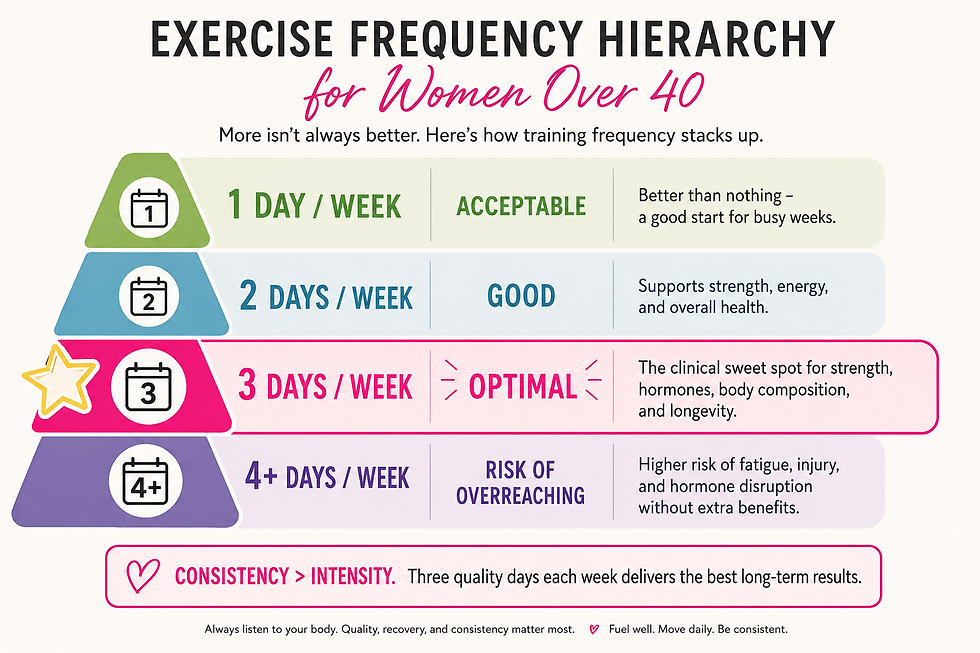
The 1 vs 2 vs 3 Hierarchy
1 day/week: Better than nothing. Prevents the worst of muscle and bone decline. The right starting point if you're rebuilding the habit.
2 days/week: The ACSM minimum recommendation. Produces clear improvements in strength, body composition, and bone density.
3 days/week: The clinical optimum for postmenopausal women. Produces the largest gains in lean mass, strength, and metabolic markers per the head-to-head research. This is what TransformFitAI is built around.
4+ days/week: Diminishing returns and increasing overreaching risk. Recovery takes ~20% longer post-menopause, and chronic high-frequency training can dysregulate the HPA axis.
What Does an Optimal Week Actually Look Like?
Day | Activity | Duration |
Monday | Strength A (full-body bodyweight) | 20–30 min |
Tuesday | Brisk walk | 30–40 min |
Wednesday | Strength B (full-body bodyweight) | 20–30 min |
Thursday | Brisk walk or yoga | 30–40 min |
Friday | Strength A or B (alternate) | 20–30 min |
Saturday | Longer walk, hike, or cycle | 45–60 min |
Sunday | Rest or gentle mobility | Optional |
Total strength: 3 sessions × 20–30 minutes = 60–90 min/week. Total aerobic: ~150 min of walking. One rest day. This matches every major clinical recommendation and stays comfortably below the overreaching threshold.
Why Don't the Guidelines Recommend 5 or 6 Days of Hard Training?
Because the evidence base in older women — and especially postmenopausal women — doesn't support it. Three specific physiological constraints emerge after 40.
Recovery takes longer. Postmenopausal women experience approximately 20% longer recovery periods after exercise, with C-reactive protein roughly 35% higher and baseline muscle damage markers elevated. (Source: Romualdi et al., Endocrines, 2024) Stacking hard sessions without adequate recovery generates more damage than the body can repair — the recipe for nonfunctional overreaching.
Cortisol management matters more. Each intense training session is an acute stressor that elevates cortisol. In a body that already has elevated cortisol from perimenopausal hormonal shifts, frequent high-intensity training compounds the stress signal — promoting visceral fat, disrupting sleep, and accelerating muscle breakdown. The cortisol equation works against you at higher frequencies.
The 2026 ACSM message: consistency beats complexity. The landmark 2026 ACSM update — synthesising 137 systematic reviews and approximately 30,000 participants — concluded that training all major muscle groups twice weekly is the primary driver of hypertrophy and functional strength. (Source: ACSM, 2026) The message wasn't "train more"; it was "train sustainably."
Postmenopausal women already show approximately 20% longer recovery periods after exercise, C-reactive protein roughly 35% higher, and elevated baseline concentrations of creatine kinase and myoglobin — the same muscle damage markers that signal accumulated tissue stress in overreaching. (Source: Romualdi et al., Endocrines, 2024; Mubarak Smith et al., Maturitas, 2023)
"The biggest mindset shift women over 40 need is treating 3 strength sessions per week as the goal, not the minimum. Most of the women I talk to are either doing 5–6 sessions and feeling chronically tired, or doing zero because they think 'real' training requires hours every day. The research is clear: 3 sessions of 20–30 minutes is what produces the best results in this population. That's why TransformFitAI is built around exactly that schedule — anything more starts to work against you after 40."
— Nikolay Atanasov, Founder of TransformFitAI
What If You Can Only Train 1 or 2 Days a Week?
Train. The evidence is unambiguous: even 1 day per week of resistance training combined with 1 aerobic session prevents the worst decline in bone density, muscle mass, and functional strength in postmenopausal women. (Source: Ellis et al., 2021)
The hierarchy is clear: 3 sessions > 2 > 1 > 0. The gap between "doing nothing" and "doing one session per week" is dramatically larger than the gap between 1 and 2, or 2 and 3. Don't let the search for the perfect frequency prevent you from training at the frequency you can sustain.
If you can only train twice per week, follow the ACSM minimum: two full-body sessions targeting all major muscle groups (squat, hinge, push, pull, lunge), 48–72 hours apart. Add walking on non-training days. This is the floor — and it produces meaningful results.
How TransformFitAI Structures the 3-Day Week
TransformFitAI is built around exactly the schedule the clinical guidelines recommend.
3 strength sessions per week, 20–30 minutes each. The clinical optimum. Long enough to deliver the muscle-preservation stimulus; short enough to fit any schedule and avoid the cortisol cost of long sessions.
Full-body compound bodyweight workouts. Squat, hinge, push, pull, lunge — the five movement patterns that train all major muscle groups in every session. For the full exercise library, see the strength exercises that protect against muscle loss.
Bi-weekly recalibration. Every 14 days, body scans inform updated programming. As you get stronger, exercise variations advance — keeping the stimulus above the adaptive threshold without adding sessions.
Walking is encouraged on non-training days. The aerobic component (150 minutes per week) sits alongside the strength programme — supporting recovery, cardiovascular health, and cortisol management without adding training stress.
Your Frequency Checklist
✓ Aim for 3 strength sessions per week. Full-body, 20–30 minutes each. The clinical optimum across every major guideline.
✓ Add 150 minutes of walking weekly. ~30 minutes of brisk walking five days per week, or any equivalent distribution.
✓ Allow at least 48 hours between sessions targeting the same muscle groups. Recovery takes ~20% longer after menopause. Respect it.
✓ If only 2 days are possible, choose 2. The ACSM minimum. Still produces meaningful gains. Better than skipping because the perfect 3-day schedule isn't realistic.
✓ If only 1 day is possible, choose 1. One resistance + one aerobic session per week prevents the worst decline. The gap from zero to one is the biggest jump.
✓ Avoid 5+ strength sessions per week. Increases overreaching risk without adding meaningful benefit for general health in women over 40.
✓ Pair every session with 25–30g of protein post-workout. The repair signal is only useful with the building material. See how much protein women over 40 need.
Ready for the 3-sessions-per-week-programme that matches the research?
TransformFitAI delivers exactly what the clinical guidelines recommend — 3 bodyweight strength sessions per week, 20–30 minutes each, full-body, joint-safe, adapted to your body every 14 days. No gym. No equipment. Try it free for your first day, then $1.99 for your first month.
$1.99 / first month
First training day completely free · 30-day money-back guarantee · Cancel anytime
Frequently Asked Questions How many days a week should a woman over 40 do strength training?
Three resistance training sessions per week is the clinical optimum across ACSM, NSCA, WHO, and the most-cited postmenopausal protocols. A 2024 randomised controlled trial in 83 postmenopausal women directly compared 2 vs 3 days per week of multicomponent training; the 3-days-per-week group showed greater improvements in lean body mass, isometric strength, and lipid profile parameters. Two sessions is the floor and still produces clear gains; three is optimal.
Is 5 or 6 days a week of exercise too much for a woman over 40?
For high-intensity strength sessions, yes. Recovery takes approximately 20% longer in postmenopausal women, with elevated baseline inflammation and disrupted sleep patterns. Five or six hard sessions per week generates accumulated damage faster than the body can repair, increasing overreaching and injury risk. However, combining 3 strength sessions with 3–4 days of moderate walking is not "too much" — walking supports recovery without adding training stress.
Can I just do 2 days a week and still see results?
Yes. The ACSM 2026 update — synthesising 137 systematic reviews — concluded that training all major muscle groups twice weekly is the primary driver of hypertrophy and functional strength. Two full-body sessions per week, with 48–72 hours between, produces meaningful improvements in muscle mass, strength, and bone density. Three sessions is optimal; two is solid.
Does walking count as one of my training days?
Walking and strength training count toward different recommendations and aren't interchangeable. The clinical recommendation is three strength training sessions per week plus 150 minutes of moderate aerobic activity (walking). Walking on a strength training day is fine — it doesn't count as a separate strength session. Think of walking as a foundation that runs alongside your strength programme rather than substituting for it.
How long should each exercise session be?
For strength training: 20–30 minutes per session is sufficient when the workout is built around compound movements and trained at appropriate intensity. Longer sessions don't produce proportionally more results and increase cortisol elevation. For aerobic activity: aim for 30 minutes of moderate walking, 5 days per week (or any equivalent distribution totalling 150 minutes weekly).
What if I work out 4 days a week — is that bad?
Not necessarily. Four sessions per week can work if structured carefully: 3 strength + 1 light cardio session, or 2 strength + 2 moderate cardio, with adequate rest days and recovery indicators (resting heart rate, sleep quality, mood) monitored. Four hard strength sessions per week starts to push recovery capacity in most women over 40. The risk increases with intensity, not just frequency — moderate-intensity work tolerates higher frequency than high-intensity work.
Scientific References
Buckinx F, Aubertin-Leheudre M. Sarcopenia in Menopausal Women: Current Perspectives. Int J Womens Health, 2022. PMC9235827
American College of Sports Medicine. ACSM Resistance Training Guidelines Update 2026 — First Update in 17 Years. ACSM, 2026. ACSM
Fragala MS, et al. Resistance Training for Older Adults: Position Statement From the NSCA. J Strength Cond Res, 2019. PubMed
Martínez-Carbonell E, et al. Impact of Multicomponent Training Frequency on Health and Fitness Parameters in Postmenopausal Women. Healthcare, 2024. PMC11475997
Ellis A, et al. Effects of Different 16-Week Exercise Interventions on Bone Mineral Density of Sedentary Older Women. GerontoGeriatrics / PMC, 2021. PMC8681684
World Health Organization. Physical Activity Fact Sheet. WHO Guidelines. WHO
Romualdi D, et al. Hormonal Influences on Skeletal Muscle Function in Women across Life Stages. Endocrines, 2024. Endocrines
International Osteoporosis Foundation. Exercise Depending on Age. IOF
Medical Disclaimer: TransformFitAI is a general wellness tool and not a substitute for medical advice. Exercise recommendations should be individualised based on existing health conditions, joint status, and medical history. Consult your physician before starting a new exercise programme or significantly changing your current routine. Individual needs may vary.


Comments