
Cardio vs. Strength Training After 40: Which Burns More Fat, Builds More Muscle, and Protects Your Joints

Quick Read: The Three-Way Verdict
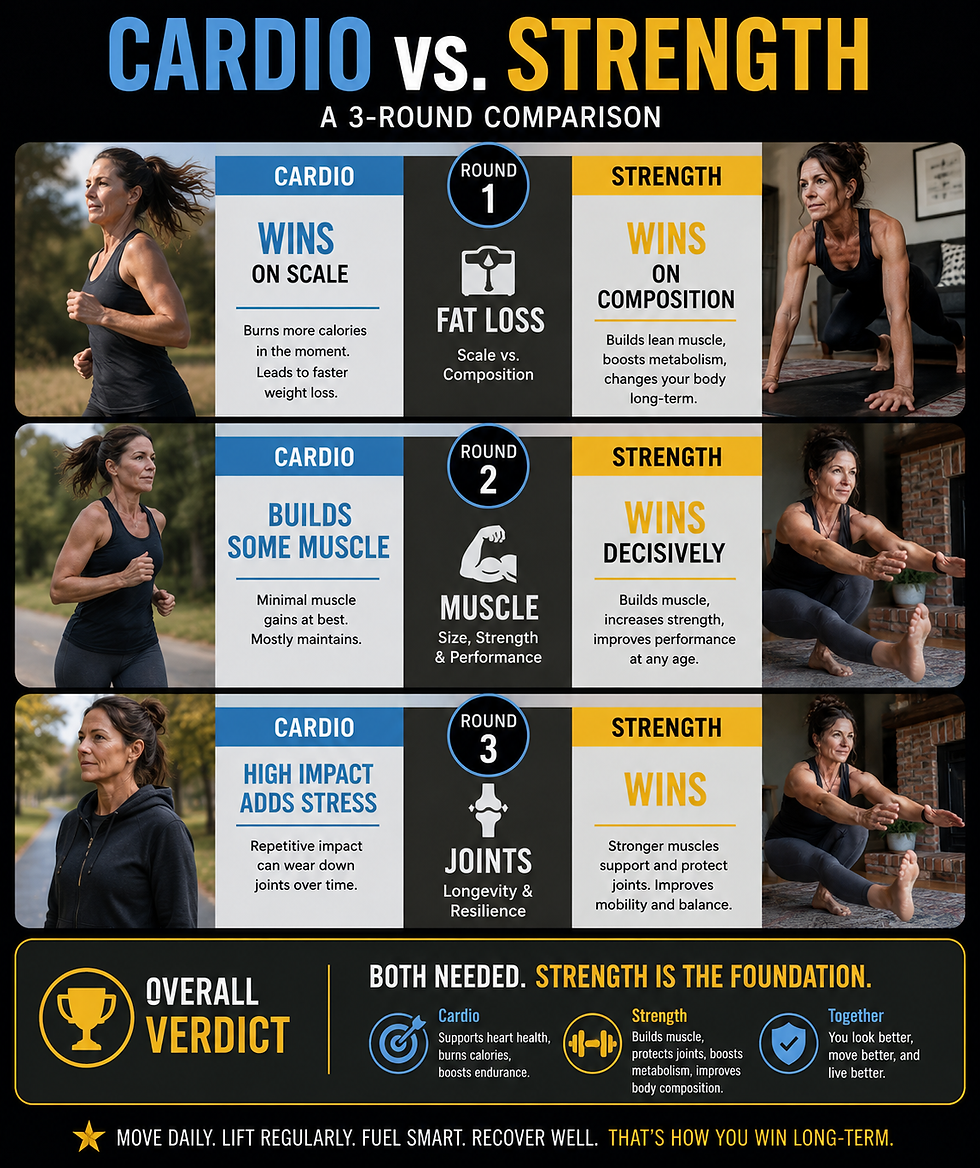
Which burns more fat? Cardio wins for total fat mass reduction. A meta-analysis of 101 studies in 5,697 postmenopausal women found aerobic training had greater effects on fat mass outcomes. But cardio also burns muscle — the tissue that keeps fat off long-term.
Which builds more muscle? Strength training wins — decisively. The same meta-analysis found only resistance training effectively increased muscle mass. Cardio had no significant effect on lean mass. Combined training achieved both fat loss and muscle gain.
Which protects joints better? Strength training wins. A 2024 meta-analysis of 27 studies (1,712 participants) found resistance training significantly improved pain, strength, and function in knee and hip osteoarthritis — the joint conditions most common after 40.
The overall verdict: After 40, the most consequential change is muscle loss — not cardiovascular fitness. Strength training addresses the root problem; cardio does not. The evidence-based recommendation: strength training 3×/week + walking 150 min/week.
"Should I do cardio or strength training?" is the wrong question after 40. The right question is: "What's the biggest threat to my health, and which exercise type addresses it?" The research answers both — and the answer shifts after menopause.
A systematic review and meta-analysis of 101 studies involving 5,697 postmenopausal women made the distinction clear: aerobic training is effective for fat loss, resistance training is effective for muscle gain, and combined training achieves both. (Source: Khalafi et al., Frontiers in Endocrinology, 2023)
This article compares cardio and strength training head-to-head across the three outcomes that matter most after 40 — fat loss, muscle preservation, and joint protection — with the specific data from each side. For a deeper dive into why cardio alone isn't sufficient, see why cardio alone won't work after 40.
Round 1: Which Burns More Fat After 40?
Winner on the scale: cardio. A meta-analysis comparing aerobic training (AT) versus resistance training (RT) head-to-head in 38 RCTs (1,682 middle-aged to older participants) found that AT significantly decreased body mass compared to RT (mean difference: -1.23 kg). AT also produced significantly greater improvements in VO2max. (Source: AT vs RT Meta-Analysis, Archives of Gerontology and Geriatrics, 2024)
A network meta-analysis in postmenopausal women further showed that aerobic exercise had the most significant effect on body fat percentage (SUCRA = 0.856), while resistance training had the greatest effect on waist circumference (SUCRA = 0.834) and fasting glucose (SUCRA = 0.929). (Source: Network Meta-Analysis, PMC12640842, 2025)
But here's the catch: cardio-driven weight loss includes both fat and muscle. Without resistance training to protect lean mass, the "weight" you lose on a cardio programme may include the very tissue you need most. The SWAN study showed that during the menopause transition, lean mass is already declining while fat is increasing. Cardio accelerates the fat loss — but it doesn't stop the muscle loss, and may worsen it. (Source: Greendale et al., SWAN, 2019)
The Fat Loss Paradox After 40
Losing weight that includes muscle lowers your resting metabolic rate, making it easier to regain fat on the same calorie intake. This is why cardio-only dieters often end up heavier than when they started within 12–24 months. Strength training preserves the metabolic engine while fat decreases — producing visible body composition improvement even when the scale moves modestly. After 40, body composition matters more than body weight.
Round 3: Which Builds More Muscle After 40?
Winner: strength training — no contest. The 101-study meta-analysis found that resistance and combined training had significantly greater effects on muscle mass outcomes in postmenopausal women, while aerobic training alone had no significant effect on lean mass or muscle cross-sectional area. (Source: Khalafi et al., 2023)
A companion meta-analysis of 129 studies in 7,141 postmenopausal women found that only resistance training increased upper-body muscular strength. Aerobic training produced no significant improvement in upper-body strength. For lower-body strength and cardiorespiratory fitness, all three modalities (aerobic, resistance, combined) produced improvements — but resistance and combined were more effective overall. (Source: Khalafi et al., Frontiers in Cardiovascular Medicine, 2023)
This matters enormously after 40 because muscle loss is the root cause of most age-related health decline. Lean mass decreases by approximately 0.5% per year while fat mass increases by 1.7% per year during the menopausal transition. (Source: Buckinx & Aubertin-Leheudre, 2022) Cardio doesn't address this. Only resistance training does. For the full muscle-loss picture, see how sarcopenia develops in women over 40.
Round 3: Which Protects Joints Better After 40?
Winner: strength training. This is the round most people don't expect — because conventional wisdom says "go easy on your joints" and associates cardio with gentleness. The research says the opposite.
A 2024 systematic review and meta-analysis of 27 studies involving 1,712 participants with knee or hip osteoarthritis found that resistance training significantly improved pain (SMD: -0.48), strength (SMD: 0.40), and function (SMD: -0.56). The improvements were significant for both knee and hip joints and increased with longer intervention durations. (Source: RT and Osteoarthritis Meta-Analysis, J Personalized Medicine, 2024)
The mechanism: stronger muscles stabilise joints, absorb impact forces, and distribute load across the joint surface more evenly. Weak muscles — the default after 40 without strength training — transfer more force directly to cartilage, tendons, and ligaments. This is compounded by declining estrogen, which reduces collagen content in connective tissue and decreases tendon elasticity. (Source: Chidi-Ogbolu & Baar, Frontiers in Physiology, 2018)
High-impact cardio (running on hard surfaces, plyometric classes) without the muscular support that strength training provides is actually the combination most likely to cause joint problems after 40 — not heavy training itself. For more on this, see is heavy lifting safe for women over 40.
The Head-to-Head Summary
Outcome | Cardio | Strength Training | Combined |
Total fat loss | Significant ✓ | Moderate | Significant ✓✓ |
Body fat % | Best single modality | Moderate | Best overall |
Waist circumference | Moderate | Best single modality | Strong |
Muscle mass | No significant effect | Significant increase ✓✓ | Significant increase ✓✓ |
Upper-body strength | No significant effect | Significant increase ✓✓ | Significant increase |
Lower-body strength | Significant increase | Significant increase ✓✓ | Significant increase ✓✓ |
Joint pain (OA) | No specific evidence | Significant improvement ✓✓ | Expected benefit |
Cardiovascular fitness | Significant increase ✓✓ | Moderate increase | Best overall ✓✓ |
Insulin / glucose | Improvement | Best single modality | Best overall |
Sources: Khalafi, Frontiers Endocrinol, 2023; Khalafi, Frontiers Cardiovasc Med, 2023; Network Meta-Analysis, 2025; RT & OA Meta-Analysis, 2024
Combined training wins overall. But the pattern is clear: after 40, the most consequential deficits are in muscle, strength, and joint protection — all of which are addressed by resistance training and not by cardio. If you can only do one, choose strength. If you can do both, lead with strength and complement with walking.
"The data doesn't say cardio is bad — it says cardio is incomplete. After 40, the biggest risks to a woman's health aren't cardiovascular; they're musculoskeletal: muscle loss, strength decline, bone thinning, and joint vulnerability. Cardio doesn't address any of those. Strength training addresses all of them. That's why TransformFitAI is a strength programme first. We built it to solve the problem that matters most — and walking handles the rest."
— Nikolay Atanasov, Founder of TransformFitAI
How to Combine Both for Maximum Benefit
The clinical recommendation for postmenopausal women: resistance training 3 times per week combined with 150 minutes of moderate aerobic activity. (Source: Buckinx & Aubertin-Leheudre, 2022)
Day | Activity | Duration |
Monday | Strength (bodyweight compounds) | 20–30 min |
Tuesday | Brisk walk | 30 min |
Wednesday | Strength (bodyweight compounds) | 20–30 min |
Thursday | Brisk walk or swim | 30 min |
Friday | Strength (bodyweight compounds) | 20–30 min |
Saturday | Longer walk, hike, or cycle | 45–60 min |
Sunday | Rest | — |
Strength is the foundation. Walking is the complement. Together they cover fat loss, muscle preservation, cardiovascular health, joint protection, and metabolic function — every outcome the research measures.
How TransformFitAI Delivers the Strength Foundation
TransformFitAI handles the strength side of the equation — the more consequential and harder-to-programme half. Walking doesn't need an algorithm. Progressive, joint-safe, adapted strength training does.
Compound bodyweight movements cover all major muscle groups. Squat, hinge, push, pull, lunge — the patterns that build muscle, protect joints, and improve metabolic markers. For the full exercise library, see the strength exercises that protect against muscle loss.
Bi-weekly adaptation prevents plateau and overuse. Every 14 days, new body scans inform updated exercise selections — built-in progressive overload that keeps the programme effective as your body adapts.
Joint-safe by design. Report sensitivity in any joint and the AI substitutes a safer variation — so you can strength-train consistently instead of cycling between injury and recovery.
20–30 minute sessions leave room for walking. The programme is designed to fit alongside 150 min/week of walking, not compete with it.
Your Cardio + Strength Balance Checklist
✓Strength train 3× per week, 20–30 minutes. Compound bodyweight movements. This addresses muscle, strength, joints, and waist circumference — the outcomes cardio can't.
✓ Walk 150 minutes per week. The ideal aerobic complement. Supports fat loss, cardiovascular health, and cortisol management without adding recovery cost.
✓Don't replace strength days with cardio. When time is short, keep the strength session. Muscle loss is harder to reverse than a missed walk.
✓ Track composition, not just weight. Cardio moves the scale. Strength changes the shape. Use waist circumference, strength benchmarks, and body scans.
✓Pair both with 25–30g protein per meal. Strength training sends the signal. Walking supports fat oxidation. Protein provides the building material.
Ready to build the strength foundation?
TransformFitAI delivers the half of the equation that matters most after 40 — progressive bodyweight strength training, adapted to your body every 14 days. No gym. No equipment. Fits alongside your daily walk. Try it free for your first day, then $1.99 for your first month.
$1.99 / first month
First training day completely free · 30-day money-back guarantee · Cancel anytime
Frequently Asked Questions What is the best exercise for fat loss after 40?
Combined training — strength plus aerobic — produces the best fat loss outcomes in postmenopausal women. Aerobic exercise alone reduces fat mass but doesn't prevent muscle loss, which lowers resting metabolic rate and makes fat regain easier. Strength training preserves the metabolic engine (muscle) while fat decreases. The evidence-based recommendation is three strength sessions per week combined with 150 minutes of moderate walking.
Does strength training burn fat?
Yes, but through a different mechanism than cardio. Cardio burns more calories during the session. Strength training increases resting metabolic rate by preserving and building muscle — the most metabolically active tissue in the body. Over weeks and months, the higher resting calorie burn from maintained muscle mass compounds. Strength training also had the greatest effect on waist circumference and fasting glucose among all exercise types in postmenopausal women, according to a network meta-analysis.
Is running bad for joints after 40?
Running itself is not inherently bad for joints. However, running without adequate muscular support increases the force transferred directly to cartilage, tendons, and ligaments. After 40, declining estrogen reduces collagen content and tendon elasticity, making connective tissue more vulnerable to repetitive impact. Building muscular strength — particularly in the muscles around the knees, hips, and ankles — provides the shock absorption and joint stability that protects against running-related injury. Strength training before or alongside running is protective.
Can I just walk for exercise after 40?
Walking is an excellent form of moderate aerobic activity that reduces cortisol, supports cardiovascular health, and contributes to fat loss. However, walking alone does not prevent muscle loss, does not build strength, does not recruit Type II muscle fibres, and does not optimally protect bone density. The clinical recommendation is walking (or equivalent aerobic activity) for 150 minutes per week combined with resistance training three times per week. Walking without strength training leaves the most consequential age-related changes unaddressed.
Does strength training help with knee pain?
Yes. A 2024 meta-analysis of 27 studies involving 1,712 participants with knee or hip osteoarthritis found that resistance training significantly improved pain, strength, and physical function. Stronger muscles around the knee absorb impact forces and distribute load more evenly across the joint surface, reducing the stress on cartilage that causes pain. Clinical guidelines recommend resistance training as a core treatment for all individuals with knee osteoarthritis.
Know More:
Scientific References
Khalafi M, Symonds ME, Rosenkranz SK. The effects of exercise training on body composition in postmenopausal women. Frontiers in Endocrinology, 2023. PMC10306117
Khalafi M, et al. Influence of exercise type and duration on CRF and muscular strength in post-menopausal women. Frontiers in Cardiovascular Medicine, 2023. PMC10204927
AT vs RT Meta-Analysis. Effect of aerobic training versus resistance training for improving CRF and body composition in middle-aged to older adults. Archives of Gerontology and Geriatrics, 2024. ScienceDirect
Network Meta-Analysis. Effect of different exercise interventions on metabolic syndrome risk factors in postmenopausal women. PMC, 2025. PMC12640842
RT and Osteoarthritis Meta-Analysis. The Effects of Resistance Training on Pain, Strength, and Function in Osteoarthritis. J Personalized Medicine, 2024. PMC11676110
Greendale GA, et al. Changes in body composition and weight during the menopause transition. SWAN / JCI Insight, 2019. PMC6483504
Chidi-Ogbolu N, Baar K. Effect of Estrogen on Musculoskeletal Performance and Injury Risk. Frontiers in Physiology, 2018. Frontiers
Buckinx F, Aubertin-Leheudre M. Sarcopenia in Menopausal Women. Int J Womens Health, 2022. PMC9235827
Medical Disclaimer: TransformFitAI is a general wellness tool and not a substitute for medical advice. If you have cardiovascular conditions, joint pain, or existing health conditions, consult your physician before starting or modifying an exercise programme. Individual results may vary.


Comments