
Joint-Friendly Strength Training for Women Over 40: Low-Impact Exercises That Still Build Muscle
Updated: Jun 1
Quick Read: The Data
Low-impact ≠ low-result. A 2020 controlled trial in older adults (ages 57–75) found that low-load resistance training using bodyweight and elastic bands — just twice per week for 12 weeks — induced significant muscle hypertrophy, increased strength, and improved physical function.
Strength training reduces joint pain. A 2025 meta-analysis of 28 RCTs in 2,164 participants found resistance training significantly reduced osteoarthritis pain (Hedges' g = −0.57), with greater benefits in women specifically. A separate network meta-analysis of 46 RCTs in 3,463 patients confirmed RT improved knee OA pain (SMD: −1.35).
The mechanism: Stronger muscles absorb and distribute joint impact forces. Weak muscles transfer that force directly to cartilage and connective tissue. Building muscle around a joint is one of the most effective ways to reduce its pain.
What "joint-friendly" actually means: Controlled tempo, full but pain-free range of motion, bodyweight or low-load resistance, no high-impact landings, and adaptive exercise selection that substitutes safer variations when a specific joint is sensitive.
The ACSM 2026 endorsement: The first ACSM resistance training update in 17 years explicitly stated that bodyweight exercises and elastic bands yield "marked benefits in strength, hypertrophy, and physical function" — no gym required.
If you're a woman over 40 who has been told to "avoid strength training" because of knee pain, shoulder issues, or general joint sensitivity — or if you've been told that "low-impact" workouts are gentle but unproductive — the research disagrees with both pieces of advice. Low-impact, joint-friendly resistance training produces meaningful muscle gains in older women. It also reduces joint pain. The two goals aren't in conflict — they reinforce each other.
This article explains how low-impact strength training works at the muscle level, what the research shows about its effectiveness, which exercises are genuinely joint-friendly without sacrificing results, and how to build a programme that protects your joints while still producing real adaptation. For the underlying safety evidence on intensity, see is heavy lifting safe for women over 40.
Does Low-Impact Strength Training Actually Build Muscle?
Yes — and the research is unambiguous. A study published in the Journal of Sports Science & Medicine tested low-load resistance training using bodyweight and elastic bands in 51 older adults (ages 57–75). The protocol: nine exercises, performed twice per week, for 12 weeks. The results: significant muscle thickness increases in the forearm, upper arm, and thigh (anterior and posterior); increased isometric knee extension strength; and improved physical function — including 8-foot up-and-go, chair stand, and grip strength. (Source: Ozaki et al., J Sports Sci Med, 2020)
A 12-week randomised controlled trial in 56 older women with sarcopenic obesity (mean age 67) found that elastic band resistance training significantly improved lean muscle mass and global physical capacity, with effects sustained at 9-month follow-up. (Source: Liao et al., Scientific Reports, 2018)
A separate 16-week trial in older women with sarcopenia tested combined bodyweight and elastic band resistance training three times per week. Researchers concluded that this form of training is "an alternative training method for sarcopenia to minimize the age-related adverse effects on muscle function and quality" — and noted its safety, portability, and practicality. (Source: Park et al., 2021)
The ACSM's landmark 2026 resistance training guidelines — the first update in 17 years, synthesising 137 systematic reviews — explicitly stated that bodyweight exercises and elastic bands yield "marked benefits in strength, hypertrophy, and physical function" and that traditional gym settings are not required. (Source: ACSM, 2026)
The shared principle: muscle adapts to the intensity of effort relative to your current capacity, not to the absolute load. A bodyweight squat performed close to failure recruits the same Type II (fast-twitch) muscle fibres as a barbell squat — without the spinal compression or knee shear forces of heavy loading.
Why Does Strength Training Actually Reduce Joint Pain?
Most women approach strength training as something to do despite joint issues. The research shows it should be approached as something to do because of them.
A 2025 dose-response meta-analysis of 28 randomised controlled trials in 2,164 participants found that resistance training significantly reduced osteoarthritis pain (Hedges' g = −0.57), with the effect sustained for up to 6 months post-intervention.
The analysis specifically identified greater benefits in females — making this finding particularly relevant for women over 40. (Source: RT for OA Pain Meta-Analysis, Frontiers in Public Health, 2025)
A separate network meta-analysis of 46 RCTs in 3,463 patients with knee osteoarthritis identified that moderate-intensity resistance training (43–47% of 1RM) significantly improved pain (SMD: −1.35), stiffness, and function. Moderate-intensity training — exactly the range achievable through bodyweight and band exercises — was effective for both pain and functional outcomes. (Source: KOA Network Meta-Analysis, BMC Musculoskeletal Disorders, 2025)
The mechanism is mechanical. Stronger muscles around a joint act as shock absorbers and stabilisers. When the quadriceps and glutes are strong, they absorb the impact of each step before it reaches the knee cartilage. When the rotator cuff is strong, it keeps the shoulder joint stable through its range of motion, reducing impingement. Weak muscles transfer that force directly to the joint surface — accelerating wear and producing pain.
After 40, this matters even more because declining estrogen reduces collagen content in tendons and ligaments, making connective tissue stiffer and more vulnerable to load. (Source: Chidi-Ogbolu & Baar, Frontiers in Physiology, 2018) The same load that bothered no one at 30 can irritate tendons at 47. The solution isn't avoiding loading — it's using load that builds muscle without exceeding what the connective tissue can tolerate.

What Makes an Exercise "Joint-Friendly"?
Five specific characteristics distinguish a joint-friendly exercise from a potentially aggravating one:
Characteristic | Why It Matters |
Controlled tempo | Slow, deliberate movements (3 seconds down, 1 second up) reduce impact forces and improve muscle recruitment |
Pain-free range of motion | Working within the range your joint tolerates today — not forcing depth that creates sharp pain |
Bodyweight or moderate resistance | No spinal compression from heavy barbell loads; no knee shear from poorly fitted machines |
No high-impact landings | Jumping and plyometrics transfer 5–10× bodyweight to the knees and hips — significant force on hormone-affected tendons |
Substitution-capable | If a movement aggravates a joint, a safer variation can target the same muscle group without abandoning the workout |
The fifth point is the most underappreciated. A truly joint-friendly programme isn't a fixed list of "gentle" exercises — it's a system that adapts to your body. A wall push-up replaces a full push-up for shoulder sensitivity. A step-up replaces a deep lunge for knee pain. A glute bridge replaces a deadlift for back issues. The exercise category remains; the variation changes.
What Are the Best Joint-Friendly Strength Exercises?
Wall Push-Up → Incline Push-Up
Chest · Shoulders · Triceps · Core
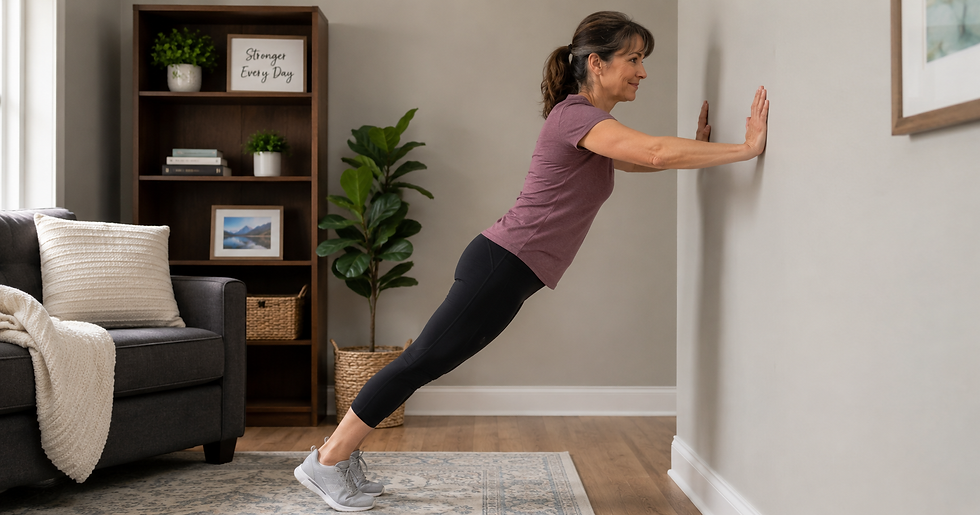
The most scalable upper-body exercise. Wall push-ups eliminate shoulder load almost entirely. As tolerance improves, progress to incline push-ups on a countertop. Both build chest, shoulder, and core strength without the rotator cuff strain of overhead pressing.
Joint protection: Keeps shoulders out of the painful overhead-loaded position. Allows scaling without compromising muscle recruitment.
Chair Squat → Bodyweight Squat → Tempo Squat
Quads · Glutes · Core
The chair provides depth control — you sit down to a target, eliminating the "how low should I go" question that creates knee anxiety. As strength improves, the chair becomes lighter touch, then optional, then unused. Tempo control (3-second descent) further reduces joint stress while increasing muscle time under tension.
Joint protection: No knee shear from forcing depth. Controlled descent prevents impact at the bottom. Engages glutes properly, reducing forward knee drift.
Glute Bridge → Single-Leg Glute Bridge
Glutes · Hamstrings · Lower back · Core
Performed lying on your back, the glute bridge places zero spinal compression and minimal knee load while training the entire posterior chain. Critical for women with lower back sensitivity. Single-leg progression increases intensity dramatically without adding equipment.
Joint protection: Supine position eliminates back compression. Smooth, lying movement places no impact on knees or hips. Builds the glutes that protect knees and lower back from future load.
Step-Up → Reverse Lunge
Quads · Glutes · Balance · Core
A low step-up (6–12 inches) trains the legs unilaterally with minimal joint stress. Reverse lunges (stepping back rather than forward) reduce forward shear on the front knee. Both build the same muscle groups as forward lunges with significantly less knee pain.
Joint protection: Step-ups eliminate the impact of lunging. Reverse lunges shift load onto the standing leg's glutes — protective for the front knee compared to forward lunges.
Inverted Row (Steep-Angle)
Upper back · Biceps · Rear delts · Core
Performed under a sturdy table or with a resistance band anchored to a door, the inverted row trains the entire back without spinal loading. Counteracts the forward-rounded posture that contributes to neck and shoulder pain. Steep-angle (closer to vertical) is the easiest progression.
Joint protection: No spinal compression. The horizontal pull pattern is protective for shoulders, building the muscles that stabilise the joint capsule.
"The biggest myth I encounter is the idea that 'joint-friendly' means 'less effective.' The research shows the opposite. Joint-friendly exercises — bodyweight progressions, controlled tempo, exercise substitutions — produce real strength and muscle gains while also reducing joint pain. They're not a compromise; they're an upgrade for any woman over 40. That's exactly what TransformFitAI is built around: every exercise is selected to give you the muscle stimulus you need without aggravating the joint sensitivities your body has now."
— Nikolay Atanasov, Founder of TransformFitAI
How Often Should Joint-Friendly Strength Training Be Done?
The clinical recommendation is the same as for general strength training in postmenopausal women: three sessions per week, 20–30 minutes each, with at least one rest day between sessions targeting the same muscle groups. (Source: Buckinx & Aubertin-Leheudre, Int J Womens Health, 2022)
The Ozaki 2020 study showed that even twice-weekly low-load bodyweight + band training produced significant muscle hypertrophy in older adults — so 2 sessions is the floor and 3 is optimal. For women with active joint flare-ups, starting at 2 sessions per week with longer recovery between is often more sustainable than pushing 3 sessions and triggering pain that derails the routine.
The Pain Signal — When to Modify vs. When to Push Through
Modify the exercise if you feel: sharp pain in a specific joint, pain that worsens through the set, swelling after the workout, or pain that lingers more than 24 hours post-exercise. These signal that the exercise is exceeding what the tissue can currently handle.Continue (with awareness) if you feel: generalised muscle burn or fatigue across multiple muscles, mild stiffness that improves with movement, or a "good" tired sensation that resolves overnight. These signal normal training adaptation.The rule: muscular discomfort is good news; sharp joint pain is information. Honour both.
How TransformFitAI Builds Joint-Friendly Programmes
The hardest part of joint-friendly training isn't the exercises — it's knowing when to substitute. TransformFitAI automates this.
The 3-Way Body Scan informs exercise selection. Posture asymmetries and movement patterns from the scan guide which exercise variations are appropriate for your body — not a generic "one size fits all" programme.
Joint sensitivity flags trigger automatic substitutions. Report knee pain and the AI substitutes step-ups for deep lunges. Report shoulder issues and overhead variations are replaced with horizontal pushing/pulling. The workout adapts to what your joints can handle today.
Progressive overload is built in. Every 14 days, the AI advances exercise variations as tolerance and strength improve — wall push-ups to incline push-ups to knee push-ups — without forcing intensity your joints aren't ready for.
20–30 minute sessions avoid joint accumulation. Long sessions that work the same joints repeatedly create inflammation. Compact, full-body sessions distribute load and respect recovery.
Your Joint-Friendly Training Checklist
✓ Use controlled tempo: 3 seconds down, 1 second up. Reduces impact, increases time under tension, builds muscle without joint stress.
✓ Work within a pain-free range of motion. Depth and range expand as tolerance improves — never force past sharp pain.
✓ Skip high-impact moves. No jump squats, no box jumps, no plyometric lunges. The 5–10× bodyweight landing force isn't worth the joint cost after 40.
✓ Substitute when needed. Wall push-up for shoulder pain. Step-up for knee pain. Glute bridge for lower back pain. Keep training, change the movement.
✓Progress gradually. Every 1–2 weeks, advance one variable: a slightly harder variation, more reps, or slower tempo. Never multiple variables at once.
✓Pair with 25–30g protein per meal. Connective tissue repair requires building material. Protein supports both muscle and tendon adaptation.
✓ Treat 7–8 hours of sleep as a joint intervention. Growth hormone released during deep sleep is essential for cartilage and tendon repair.
Ready for strength training that respects your joints ?
TransformFitAI builds a complete bodyweight strength programme around joint-friendly exercise selection — with automatic substitutions when something flares up. Real muscle gains. No joint compromise. No gym. Try it free for your first day, then $1.99 for your first month.
$1.99 / first month
First training day completely free · 30-day money-back guarantee · Cancel anytime
Frequently Asked Questions Can you build muscle with low-impact exercises?
Yes. A 12-week controlled trial in older adults (ages 57–75) found that low-load resistance training using bodyweight and elastic bands — performed just twice per week — produced significant muscle thickness increases in the forearm, upper arm, and thigh, along with improved strength and physical function. The ACSM's 2026 resistance training guidelines explicitly state that bodyweight exercises and elastic bands yield "marked benefits in strength, hypertrophy, and physical function." Muscle adapts to relative intensity, not absolute load.
Does strength training make joint pain worse or better?
Better — significantly. A 2025 meta-analysis of 28 randomised trials in 2,164 participants found that resistance training reduced osteoarthritis pain (Hedges' g = −0.57), with greater benefits in women specifically. A separate network meta-analysis of 46 RCTs in 3,463 knee OA patients confirmed RT improved pain (SMD: −1.35), stiffness, and function. The mechanism: stronger muscles around a joint absorb impact forces, reducing the load that reaches cartilage and connective tissue.
What are the best joint-friendly exercises for women over 40?
The five most effective joint-friendly movement patterns are: wall or incline push-ups (chest/shoulders), chair or tempo bodyweight squats (legs/glutes), glute bridges and single-leg glute bridges (posterior chain), step-ups and reverse lunges (unilateral leg strength), and inverted rows under a table or with resistance bands (back/shoulders). Each can be progressed in difficulty without changing the joint-loading pattern that makes it safer.
Should I exercise through joint pain?
Distinguish between muscular discomfort (the burn in the last reps — normal training stimulus) and sharp, localised joint pain (a signal to modify). If a movement causes sharp joint pain, substitute a safer variation that works the same muscle group rather than skipping the session. Pain that lingers more than 24 hours post-workout, or worsens through the session, indicates the exercise is exceeding current tolerance. The rule: modify the movement, don't abandon the training.
Are resistance bands as effective as weights for older women?
For most older women, yes. Research on elastic band training in women over 60 has shown significant improvements in muscle mass, strength, and physical capacity. Resistance bands provide controlled tension throughout the movement, are gentler on joints than heavy free weights, and can be combined with bodyweight exercises for a complete programme. The ACSM's 2026 update endorses bands as producing meaningful hypertrophy and functional strength. For more advanced trainees, external load may eventually be needed — but most women over 40 progress for months or years on bands and bodyweight alone.
How quickly will I see results from joint-friendly strength training?
Strength improvements typically appear within 2–4 weeks. Joint pain reductions in research trials are documented within 6–12 weeks, with effects sustained for up to 6 months post-intervention. Visible muscle changes follow at 8–16 weeks. Critically, joint pain often improves before visible muscle changes — meaning women experiencing knee or shoulder pain may feel better doing strength training within 1–2 months, even if the scale and mirror are slower to show changes.
Scientific References
Ozaki H, Sawada S, et al. Muscle Size and Strength of the Lower Body in Supervised and in Combined Supervised and Unsupervised Low-Load Resistance Training. J Sports Sci Med, 2020. PMC7675625
Liao CD, et al. Effects of elastic resistance exercise on body composition and physical capacity in older women with sarcopenic obesity. Scientific Reports, 2018. Nature
Park J, et al. Effects of 16 Weeks of Resistance Training on Muscle Quality and Muscle Growth Factors in Older Adult Women with Sarcopenia. 2021. PMC8267934
American College of Sports Medicine. ACSM Resistance Training Guidelines Update 2026. ACSM, 2026. ACSM
RT for OA Pain Meta-Analysis. Optimizing resistance training for pain management in knee and hip osteoarthritis. Frontiers in Public Health, 2025. PMC12436098
KOA Network Meta-Analysis. Optimal resistance training strategies for knee osteoarthritis symptom relief. BMC Musculoskelet Disord, 2025. PMC12821314
Chidi-Ogbolu N, Baar K. Effect of Estrogen on Musculoskeletal Performance and Injury Risk. Frontiers in Physiology, 2018. Frontiers
Buckinx F, Aubertin-Leheudre M. Sarcopenia in Menopausal Women. Int J Womens Health, 2022. PMC9235827
Medical Disclaimer: TransformFitAI is a general wellness tool and not a substitute for medical advice. If you have a diagnosed joint condition, recent injury, or post-surgical limitations, consult your physician or physiotherapist before starting a new exercise programme. Sharp, persistent, or worsening pain warrants medical evaluation. Individual results may vary.


Comments