
Why Can't I Lose Weight After 40? The Role of Muscle Loss, Hormones, and Metabolic Slowdown

Quick Read: The Three Reasons
It's not about effort or willpower. A 2024 Mayo Clinic review found that midlife women gain an average of 0.7 kg per year — regardless of starting age or menopause status. This is a physiological pattern, not a personal failure.
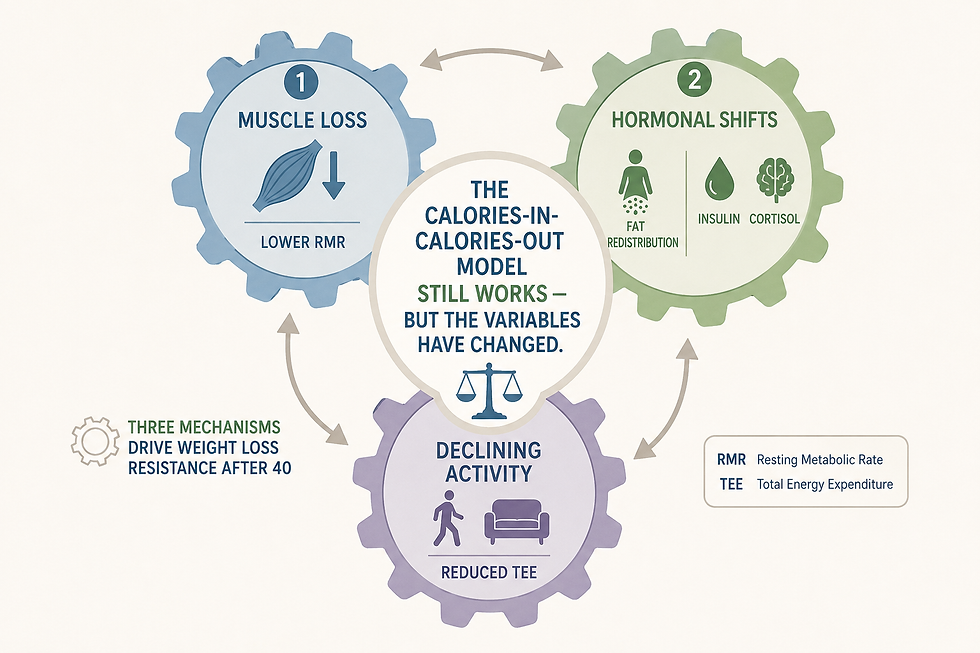
Reason 1 — Muscle loss. Adults lose 3–8% of muscle mass per decade after age 30, accelerating after 40. Less muscle means lower resting metabolic rate — your body burns fewer calories even at rest. Without resistance training, this loss is automatic.
Reason 2 — Hormonal shifts. Declining estrogen drives fat storage from hips/thighs to the abdomen, reduces insulin sensitivity, lowers leptin (satiety) signalling, and elevates cortisol. The hormones that helped weight loss at 30 now work against it.
Reason 3 — Metabolic slowdown — but not how you think. Your cellular metabolism doesn't crash at 40 (it stays stable until 60). What changes is the amount of metabolically active tissue (muscle) and physical activity — both decline, lowering total calorie burn.
What works: Strength training 3×/week, protein 25–30g per meal, walking 150 min/week, and sleep protection. Not crash diets. Not more cardio. The combination addresses all three mechanisms.
If you're a woman over 40 who has been eating the same way you always did, exercising the same way you always did, and watching the scale move in the wrong direction — you're not imagining it, and you're not failing. A 2024 Mayo Clinic review of weight gain in midlife women found that women gain an average of 0.7 kg per year through midlife, independent of starting age or menopause status. This isn't a willpower problem. It's a physiological pattern, well-documented and well-understood. (Source: Hurtado et al., Current Obesity Reports, Mayo Clinic, 2024)
The harder question is why. The honest answer is that three specific physiological mechanisms converge after 40 — muscle loss, hormonal shifts, and what's misleadingly called "metabolic slowdown" — and none of them respond to the diet-and-cardio strategies that worked at 30. This article explains each mechanism and what the research shows actually works.
What Are the Three Mechanisms Behind Weight Loss Resistance After 40?
Muscle Loss Lowers Your Metabolism by Stealth
Adults lose approximately 3–8% of muscle mass per decade after age 30, and the rate accelerates after menopause due to declining estrogen. By the time most women are in their late 40s, they may have lost 4–5 kg of lean muscle without ever noticing it on the scale — because fat replaced it pound for pound, keeping the total weight relatively stable. (Source: Buckinx & Aubertin-Leheudre, Int J Womens Health, 2022)
This matters because muscle is metabolically active tissue. Every kilogram of muscle adds approximately 13 kcal per day to your resting metabolic rate. Lose 4 kg of muscle, and you've quietly reduced your daily calorie burn by approximately 50 kcal — equivalent to about 2 kg of fat per year of unintended weight gain, even with no change in eating.
The reverse is also true: preserving and rebuilding muscle through resistance training is the only intervention that directly addresses this. Cardio doesn't preserve muscle. Diet alone doesn't preserve muscle. Crash diets actively accelerate muscle loss. Strength training is the specific tool.
The breakthrough: Resistance training 3× per week with compound movements (squat, hinge, push, pull, lunge). This is the only intervention that preserves the metabolic engine that determines how many calories you burn at rest.
Hormonal Shifts Rewrite the Rules of Fat Storage
During perimenopause and menopause, declining estrogen triggers a cascade of changes that directly affect weight regulation. Estrogen normally promotes fat storage in subcutaneous tissue (hips, thighs). When it declines, fat storage shifts to visceral tissue around the abdomen — the metabolically dangerous fat that surrounds organs. The SWAN study showed that fat gain doubled at the onset of menopause while lean mass simultaneously declined. (Source: Greendale et al., SWAN, 2019)
Three hormonal changes compound this:
Insulin sensitivity declines — more glucose ends up stored as fat rather than used for energy.
Leptin signalling decreases — you feel less satisfied after meals, with appetite-suppressing signals dampened.
Cortisol rises — promoting visceral fat storage and disrupting sleep, which further worsens insulin sensitivity.
The hormonal environment that supported weight loss at 30 is no longer present at 47. The same calorie deficit produces different results because the body's storage rules have changed.
The breakthrough: Resistance training improves insulin sensitivity and helps blunt cortisol elevation. Adequate sleep and stress management aren't optional — they're hormonal interventions. Yoga has been shown to reduce cortisol by 8.4% in 3 months in menopausal women.
"Metabolic Slowdown" — But Not Cellular Metabolism
The most-cited myth about weight gain after 40 is "your metabolism crashes." The reality is more nuanced and more useful. The largest study of human metabolism ever conducted — 6,421 people across 29 countries, published in Science in 2021 — found that total daily energy expenditure, adjusted for body size, remains stable from age 20 to age 60. Cellular metabolism doesn't decline meaningfully until after 60. (Source: Pontzer et al., Science, 2021)
So why does it feel like your metabolism has slowed? Because two things you can control have changed:
Muscle mass declines (Mechanism 1) — reducing total calorie burn at rest.
Physical activity drops — measured activity falls approximately 50% during the early menopause transition, driven by biology (rising cortisol, sleep disruption, hormonal fatigue), not laziness. (Source: Kohrt, University of Colorado Anschutz, 2025)
Your per-kilogram metabolic rate is fine. What you've lost is the metabolic engine (muscle) and the daily energy expenditure (activity) that together determined how many calories you burned at 30. The good news: both are addressable.
The breakthrough: Strength training rebuilds the metabolic engine. Walking 150 minutes per week restores the daily energy expenditure. Together, they recover most of what was lost — without "fixing" a metabolism that was never actually broken.
Why Doesn't Eating Less Work Anymore?
Because eating less attacks the wrong variable. The instinct to "just cut more calories" makes physiological sense for a 30-year-old whose muscle and hormones are intact. After 40, severe calorie restriction does two things that make weight loss harder, not easier.
It accelerates muscle loss. Without adequate protein and a training stimulus, large calorie deficits cause the body to break down lean tissue alongside fat. Less muscle means a lower resting metabolic rate, which makes the next round of weight loss harder still. This is why crash diets reliably end with women heavier than when they started. (Source: Buckinx & Aubertin-Leheudre, 2022)
It triggers metabolic adaptation. When weight loss is rapid, the body lowers its resting metabolic rate by approximately 46–54 kcal/day below what would be predicted by the new body size. This adaptation persists even after weight stabilises and is one of the main reasons weight returns. (Source: Martins et al., Obesity, 2022)
The implication: weight loss after 40 has to be slow, protein-protected, and strength-supported — or it doesn't last. Aggressive deficits backfire by attacking the muscle you most need to preserve.
"The women I work with often tell me they've tried 'everything' to lose weight after 40 — and what they mean is they've tried every diet. None of them are wrong about effort. They're wrong about strategy. After 40, the equation isn't 'eat less, move more.' It's 'preserve muscle, manage hormones, restore activity.' The women who break through aren't the ones with the most willpower — they're the ones who stop dieting and start strength training. TransformFitAI is built around exactly that pivot."
— Nikolay Atanasov, Founder of TransformFitAI
What Actually Works for Weight Loss After 40?
The evidence converges on a four-part strategy that addresses all three mechanisms simultaneously.
Intervention | Which Mechanism It Addresses |
Resistance training 3× per week | Muscle loss; insulin sensitivity; bone density; hormonal markers (GH, IGF-1, testosterone, DHEA) |
Protein 25–30g per meal | Anabolic resistance; muscle preservation during weight loss; satiety |
Walking 150 minutes per week | Declining activity; cortisol; insulin sensitivity; cardiovascular health |
Sleep protection (7–8 hours) | Cortisol; leptin; ghrelin; growth hormone; metabolic adaptation |
Synthesised from: Khalafi et al., 2023; Paddon-Jones & Rasmussen, 2009; Buckinx, 2022
The Mindset Shift
Stop measuring success by the scale. The scale tells you total weight, not body composition. Two women of identical weight can have completely different metabolic profiles depending on their muscle-to-fat ratio. After 40, the relevant measurements are waist circumference (visceral fat), strength benchmarks (muscle quality), and how clothes fit (body composition). These can all improve dramatically even when the scale moves modestly — and they matter more for health.
How TransformFitAI Helps
TransformFitAI was built around the single most-impactful lever in the four-part strategy: resistance training. The other three (protein, walking, sleep) are simple to implement on your own. Strength training — the one that addresses muscle loss, insulin sensitivity, and the hormonal environment — is the harder one to programme correctly. That's where the app fits.
3 sessions per week, 20–30 minutes each. Exactly the clinical recommendation. Long enough to drive adaptation; short enough to avoid the cortisol cost of marathon sessions.
Compound bodyweight movements. Squat, hinge, push, pull, lunge — the patterns that preserve the most muscle in the least time. No gym, no equipment.
Bi-weekly adaptation. As you get stronger, the AI advances exercise variations — keeping the muscle-preservation signal active without ever requiring you to figure out progression yourself.
Joint-friendly substitutions. If a movement aggravates a joint, the AI substitutes a safer variation. Consistency is the most important variable for long-term results, and joint pain is the most common reason women stop training.
The Weight Loss After 40 Checklist
✓ Stop crash dieting. Aggressive deficits accelerate muscle loss and trigger metabolic adaptation, making weight loss harder long-term.
✓ Strength train 3 times per week. The single most-impactful intervention. Compound bodyweight movements, full-body sessions of 20–30 minutes.
✓ Eat 25–30g of protein at every meal. Not just dinner. Each meal is a separate muscle-preservation signal — essential during weight loss.
✓ Walk 150 minutes per week. The aerobic complement that supports cardiovascular health, manages cortisol, and restores daily activity.
✓Sleep 7–8 hours. Growth hormone release peaks in deep sleep; sleep loss raises cortisol and reduces leptin (satiety).
✓Measure waist circumference, not just weight. Body composition matters more than total weight after 40 — and improves before the scale moves.
✓ Be patient through weeks 1–8. Strength improves first, then composition, then visible appearance. The programme is working before you can see it.
Ready to stop dieting and start losing weight ?
TransformFitAI delivers the single most-impactful lever for weight loss after 40 — progressive bodyweight strength training, adapted to your body every 14 days. No gym. No equipment. Try it free for your first day, then $1.99 for your first month.
$1.99 / first month
First training day completely free · 30-day money-back guarantee · Cancel anytime
Frequently Asked Questions Why can't I lose weight after 40 even though I'm eating less?
Three mechanisms converge after 40 that didn't apply at 30. First, muscle loss lowers your resting metabolic rate (every kg of muscle adds ~13 kcal/day to baseline burn). Second, declining estrogen reduces insulin sensitivity, lowers leptin (satiety), and elevates cortisol — meaning the same calories produce different metabolic outcomes. Third, physical activity drops by approximately 50% during the early menopause transition. Severe calorie restriction worsens the first mechanism by accelerating muscle loss, which is why "eat less" can backfire.
Does metabolism really slow down at 40?
Not in the way most people think. The largest study of human metabolism — 6,421 people, published in Science in 2021 — found that total daily energy expenditure, adjusted for body size, remains stable from age 20 to age 60. What does change is the amount of metabolically active tissue (muscle) and physical activity — both decline, reducing total calorie burn even though per-kilogram metabolic rate stays stable. The "slowdown" is real but it's about muscle and activity, not cellular metabolism.
What is the best diet for weight loss after 40?
No diet alone produces durable weight loss after 40. The evidence-based strategy is a moderate calorie deficit (not extreme) combined with high protein (1.2+ g/kg/day, distributed 25–30g per meal), resistance training 3× per week, walking 150 minutes per week, and sleep protection. Mediterranean-style eating patterns score well for cardiovascular and metabolic health, but the specific dietary template matters less than the protein adequacy and the addition of strength training.
Will hormone replacement therapy help me lose weight?
HRT is not designed as a weight loss treatment. However, it can improve insulin sensitivity, preserve lean mass, and reduce visceral fat accumulation when combined with strength training — partially restoring the more favourable pre-menopausal hormonal environment for body composition. The decision should be made with a menopause-informed physician based on individual risk-benefit factors. HRT is not a substitute for the behavioural strategies (strength training, protein, sleep) — it can complement them.
Why does belly fat increase after 40 even when my weight stays the same?
Declining estrogen shifts fat storage from subcutaneous tissue (hips, thighs) to visceral tissue around the abdomen. This redistribution happens independent of total weight change — meaning your scale weight can stay constant while your waist circumference increases. The SWAN study showed that the rate of fat gain doubled during the menopause transition while lean mass simultaneously declined. Two women of identical weight can have very different metabolic risk profiles depending on where their fat is stored.
How long will it take to see weight loss results after 40?
With the strength-first protocol, expect strength and energy improvements in 2–4 weeks, body composition changes (firmer arms, slimmer waist) in 6–12 weeks, and visible appearance changes in 8–16 weeks. The scale typically moves slowly because muscle gained during this period partially offsets fat lost — but waist circumference, how clothes fit, and strength benchmarks all improve faster than scale weight. Patience through the first 4–8 weeks is critical. The programme is working before it shows.
Scientific References
Hurtado MD, Saadedine M, Kapoor E, Shufelt CL, Faubion SS. Weight Gain in Midlife Women. Current Obesity Reports (Mayo Clinic), 2024. PMC11150086
Buckinx F, Aubertin-Leheudre M. Sarcopenia in Menopausal Women: Current Perspectives. Int J Womens Health, 2022. PMC9235827
Pontzer H, Yamada Y, Sagayama H, et al. Daily Energy Expenditure Through the Human Life Course. Science, 2021. PMC8370708
Greendale GA, Sternfeld B, et al. Changes in body composition and weight during the menopause transition. JCI Insight / SWAN, 2019. PMC6483504
Khalafi M, Symonds ME, Rosenkranz SK. The effects of exercise training on body composition in postmenopausal women. Frontiers in Endocrinology, 2023. PMC10306117
Martins C, et al. Metabolic adaptation delays time to reach weight loss goals. Obesity, 2022. PubMed
Paddon-Jones D, Rasmussen BB. Dietary protein recommendations and the prevention of sarcopenia. Curr Opin Clin Nutr Metab Care, 2009. PMC2760315
Kohrt WM. Menopause and Exercise. University of Colorado Anschutz, 2025. CU Anschutz
Medical Disclaimer: TransformFitAI is a general wellness tool and not a substitute for medical advice. Weight changes can be influenced by medical conditions including thyroid dysfunction, PCOS, medication side effects, and other factors. Consult your physician if you experience unexplained or rapid weight changes, are considering hormone replacement therapy, or before significantly changing your diet or exercise programme. Individual results may vary.


Comments