
The Menopause Metabolism Myth: Why Your 20s Workout Fails at 45
Updated: Mar 27

QUICK READ: THE DATA
The Metabolic Myth: Your metabolism isn't "broken"; it is responding to a loss of muscle mass and shifting insulin sensitivity.
The Cortisol Barrier: High-intensity "grinding" cardio can spike cortisol, signaling the body to store abdominal fat as a survival mechanism.
Allostatic Load: Midlife fitness is about managing your "total stress load," not just burning calories.
The AI Strategy: TransformFitAI uses controlled resistance to build the metabolic engine (muscle) while protecting you from stress-induced burnout.
"I’m eating less and moving more, but nothing is changing."
If that sentence feels like your daily mantra, you aren't alone. For many women over 40, this frustration is tied to the menopause metabolism myth - the common belief that weight gain during midlife is simply a matter of eating too much or exercising too little.
The truth? Your metabolism isn't "broken"—it’s just operating under a new set of biological rules.
The Menopause Metabolism Myth
The idea that your metabolism permanently "shuts down" during this transition is a myth.

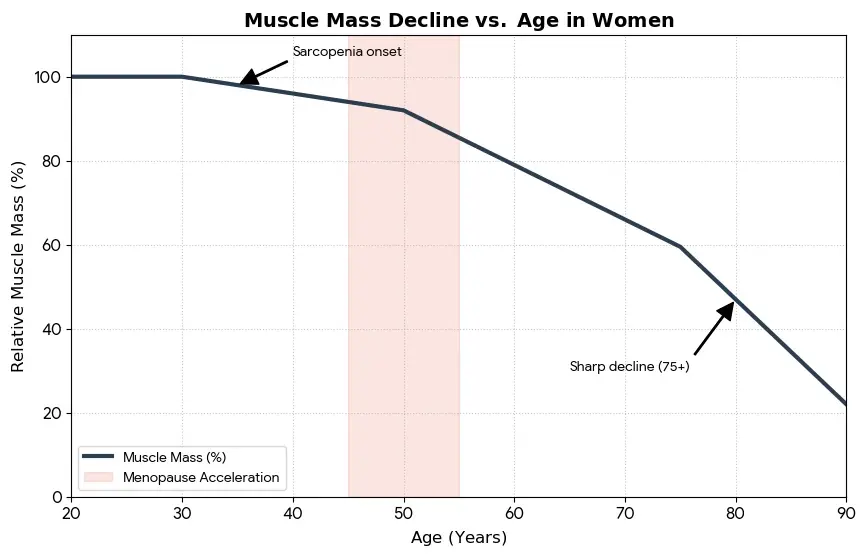
While it is a common myth that our metabolism simply 'breaks' as we age, the reality is more closely tied to what is happening beneath the surface of our skin. As shown in the first chart, a woman’s Basal Metabolic Rate (BMR) remains remarkably stable for decades, only beginning a true biological slowdown after age 60. However, many women experience a frustrating 'metabolic stall' much earlier, typically during the menopausal transition. The key to this mystery lies in the second chart: the steady decline of lean muscle mass. Because muscle is the primary engine driving our resting metabolism, the loss of this high-energy tissue—which accelerates significantly during menopause—creates a secondary 'metabolic drag.' In short, your metabolism isn't necessarily slowing down because of your age; it’s slowing down because it has less muscle to fuel.
The reality is that your biology is changing, and your fitness strategy must adapt to keep pace.
The Science of the "Shift"
The true metabolic story of menopause is about hormonal fluctuations that impact how your body uses energy.
Insulin Sensitivity: Estrogen helps manage how your cells respond to insulin. As levels fluctuate, your body may become less efficient at processing carbohydrates, making it easier to store energy as fat rather than fuel.
The Cortisol Connection: Your body becomes more sensitive to Cortisol (the stress hormone). High-intensity, long-duration cardio can signal to your body that it is under "stress," causing it to hold onto abdominal fat as a survival mechanism.
Body Composition Change: As discussed in our previous article on [Sarcopenia in Women Over 40], muscle is metabolically expensive tissue. If you lose muscle, your Resting Metabolic Rate (RMR) decreases.
Why the "Old Ways" of Training Backfire
In your 20s, you could out-train a poor diet. After 45, 'grinding' harder creates an Allostatic Load—a total stress burden—that your body can no longer recover from as easily. When you exceed this biological limit, your metabolism doesn't speed up; it shuts down to protect itself:
Excessive Cardio and Cortisol: Long, steady-state sessions spike cortisol, contributing to muscle breakdown and abdominal fat storage.
The 'Light Weights' Trap: To counteract the natural decline in muscle efficiency, you need a safe, personalized level of resistance that challenges your musculoskeletal system.
Building a Better Engine with TransformFitAI
Building a better engine isn't just about the muscles; it's about the brain. By varying your movements, the AI keeps your nervous system engaged, ensuring your metabolism stays 'awake' and efficient."
By focusing on smart, controlled resistance training—like the protocols found in TransformFitAI (available for iOS and Android) — you are essentially upgrading your internal engine

Image Content: A fit, vibrant woman in her late 40s/early 50s doing a controlled compound lift (like a deadlift or squat) with good form.
Caption: “Adaptive strength training, not endless cardio, is the foundation for metabolic health during the menopausal transition.”
Our AI engine focuses on:
Precision Resistance: Utilizing compound movements (squats, hinges, presses) to provide the most efficient metabolic stimulus.
Prioritizing Tension Over Sweat: Slow, controlled movements create "Time Under Tension," signaling the body to build muscle.
Recovery Optimization: The AI automatically builds in lighter "deload" weeks to align with your body’s need for rest, helping you avoid cortisol spikes.
The Safe Strength Checklist
Protein is Non-Negotiable: To support the "engine" you’re building, ensure you're getting adequate protein throughout the day.
Sleep is a Workout: Your metabolism regulates itself during deep sleep; prioritize 7–8 hours.
Check Your Posture: Use the AI Scan to ensure your alignment is supporting your movement.
Start Slow: If you haven't trained in years, start with 15-minute sessions.
Ready to upgrade your metabolic engine?
Stop the "cardio-burnout" cycle and start training for your biology. Get your first month of TransformFitAI for just $1.99 and get your 3-Angle Body Analysis today.


30-Day Money-Back Guarantee. Cancel Anytime.
Read Next in the Longevity Lab Series:
Scientific References (External Links):
[1] Review of Estrogen's Role in Insulin Sensitivity: https://pubmed.ncbi.nlm.nih.gov/34102108/.
[2] Study on Progressive Overload for BMR in Aging Women: https://pmc.ncbi.nlm.nih.gov/articles/PMC10559623/
Disclaimer: TransformFitAI is a general wellness tool. Metabolic changes can be influenced by various health factors; please consult with an endocrinologist or primary care physician regarding specific hormonal health concerns.


Comments